
New London County Criminal Court Records
A criminal court record is the case-level file kept by the Superior Court once a criminal or qualifying motor vehicle matter is opened. In New London County, the record is not kept by a county clerk or district clerk. Connecticut uses a statewide Superior Court system, with New London Judicial District, GA 10 New London, and GA 21 Norwich serving key local criminal and motor vehicle functions.
The record can begin with charges filed after arrest or summons, then continue through arraignment, pretrial dates, motions, plea or trial, disposition, and sentencing. For a closer look at the charge list itself, the court charge page covers arrest records and court charges. For the broader set of civil, family, probate, and court-event records, use the main New London County court records page.
Search New London County Criminal Court Records
The main online source is the Judicial Branch criminal and motor vehicle system. Pending criminal and motor vehicle cases can be searched by defendant name or docket number. Daily dockets can be searched by defendant or court. Conviction searches can be searched by defendant or docket number. The court-location dropdowns include New London Geographical Area 10, New London Judicial District, and Norwich Geographical Area 21, along with statewide court locations.
- Start at the pending criminal and motor vehicle defendant search when the case may still be open.
- Use last name first, then narrow with first initial, birth year, court location, or the Criminal and Motor Vehicle category filters.
- Try docket-number searches when the exact docket number is available from a notice, prior result, or court paper.
- Use conviction search only for conviction results and read its display limits before treating a blank result as a clean history.
- Call the Chief Clerk's Office for certified copies, sealed-access questions, or case-file records that do not appear online.
The Division of Criminal Justice is not the public criminal-records office. Its criminal records routing note directs the public to State Police, Judicial Branch, or DOC records. Formal Connecticut criminal history reports belong with DESPP and the criminal history request process, not the court docket search.
The criminal and motor vehicle conviction search shows the conviction lookup route.
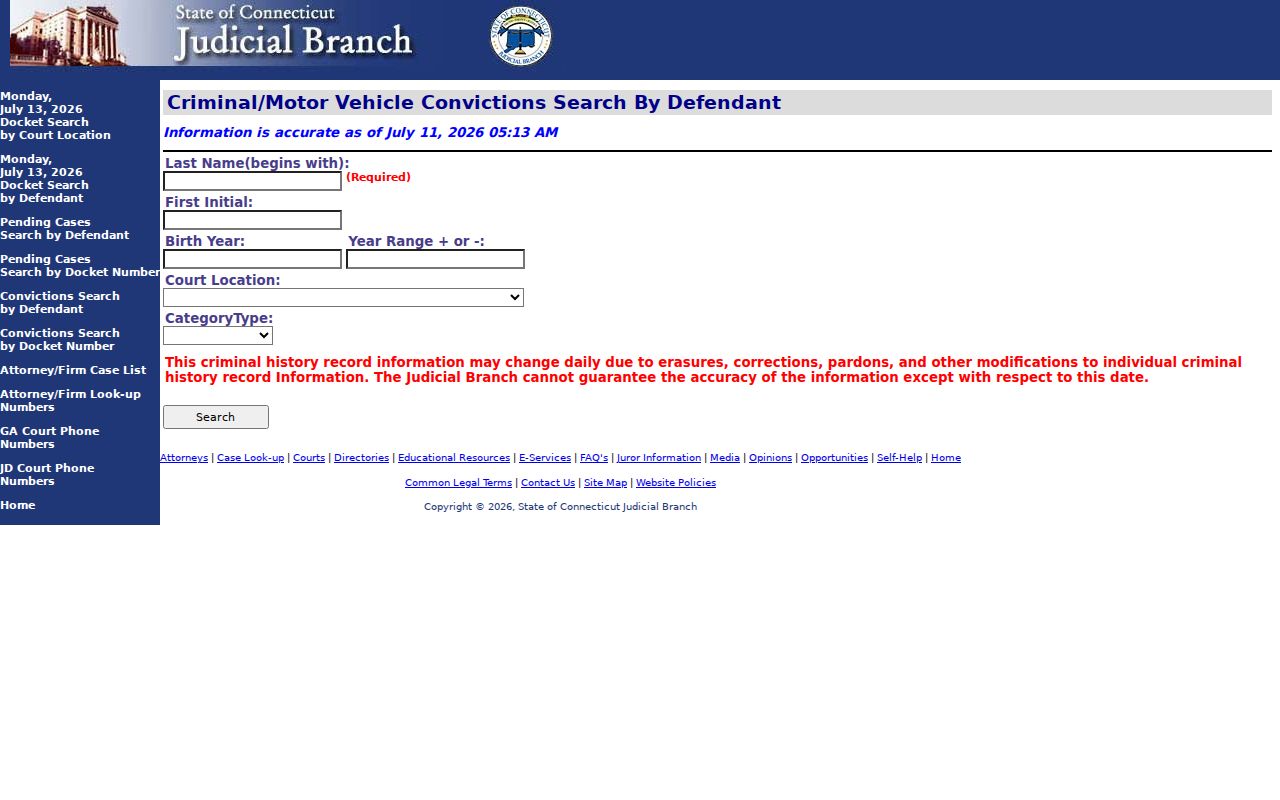
Conviction lookup is narrower than a full criminal case search, and its own notice excludes several record types from public display.
New London County Criminal Case Flow
Criminal court records are easiest to read as a sequence. The charge starts the court case, but the file grows as the court schedules hearings, receives motions, records pleas, and enters the outcome. Some records remain pending for a time. Others end through dismissal, nolle, guilty plea, trial verdict, sentence, pardon, erasure, or later correction.
Case flow: Charges Filed › Arraignment › Pretrial / Motions › Plea or Trial › Disposition › Sentencing
| Stage | What Happens |
|---|---|
| Charges filed | The prosecutor files charges with the court after arrest, summons, or review. |
| Arraignment | The defendant appears, receives advisements, and the court addresses plea or release issues. |
| Pretrial and motions | The docket may show continuances, motions, conferences, and hearing dates. |
| Plea or trial | The case resolves by plea, trial verdict, dismissal, nolle, or other court action. |
| Disposition and sentence | The final or current outcome and penalty appear when public and not restricted. |
What New London County Criminal Records Show
The public criminal and motor vehicle interface showed the page title "Pending Criminal/Motor Vehicle - Search By Defendant Name" and an information timestamp during research. Search fields included last name, first initial, birth year, year range, court location, and category type. The visible court-location options included New London GA 10, New London Judicial District, and Norwich GA 21. Those fields support public lookup, but they do not guarantee document downloads.
| Field | What It Shows |
|---|---|
| Docket number | The criminal or motor vehicle case identifier used in court and clerk requests. |
| Defendant | The person charged, subject to juvenile, youthful offender, sealing, and erasure limits. |
| Court location | The local or statewide Superior Court location assigned to the matter. |
| Charges | The offense descriptions or categories filed with the court. |
| Case status | Whether the matter is pending, disposed, convicted, dismissed, nolled, or otherwise changed. |
| Events | Daily docket entries, hearings, arraignments, continuances, motions, and court dates. |
| Disposition | The case or charge outcome when public. |
| Sentence | The penalty after conviction where public and available. |
New London County Charges vs Convictions
A charge is an accusation filed in court. A conviction is an outcome after a guilty plea, trial verdict, or equivalent public conviction event. New London County criminal court records may show charges that are later amended, reduced, nolled, dismissed, or erased. A pending charge should not be read as a conviction, and DOC custody status should not be read as a conviction either because Connecticut may hold people in accused status awaiting trial.
| Point | Charge | Conviction |
|---|---|---|
| Meaning | An accusation filed with the court. | A public outcome based on guilt or equivalent legal result. |
| Timing | Appears near the start of the case. | Appears after plea, verdict, or qualifying disposition. |
| Can change | May be amended, reduced, dropped, dismissed, or nolled. | May be affected by erasure, pardon, correction, or display limits. |
| Search route | Pending case and docket searches. | Conviction search and formal DESPP history routes. |
Read Criminal Dispositions and Sentences
Disposition is the outcome of a charge or case. In Connecticut records, a disposition can include a conviction, dismissal, nolle, acquittal, or other court result. A sentence is the penalty after conviction, such as incarceration, probation, fine, or other conditions. Probation matters can later produce violation of probation records or warrants, so a sentence entry can be the start of later docket activity.
Conviction display has limits. The criminal lookup page says conviction information generally appears for no more than 10 years after sentencing unless Practice Book section 7-13 creates a shorter display period. It also says conviction information is removed one month before the end of the applicable period. The same public notice excludes youthful offender cases, juvenile cases, and infractions and violation convictions.
Note: A blank conviction search result is not the same as a formal DESPP criminal history report.
Sealed and Erased Criminal Records
Connecticut uses erasure language for qualifying criminal records. CGS 54-142a addresses erasure in qualifying circumstances, and the Judicial Branch warns that criminal history information may change daily because of erasures, corrections, pardons, and other modifications. A sealed record is restricted from public access by rule or order. Erasure treats eligible records as unavailable to most public inquiries.
| Point | Sealed | Erased |
|---|---|---|
| Public visibility | Restricted from ordinary public access. | Unavailable to most public inquiries when eligible. |
| Source | Court rule, statute, or court order. | Connecticut erasure law and related case action. |
| Example context | Sealed documents, restricted proceedings, or protected case details. | Dismissed, nolled, pardoned, or otherwise eligible criminal records. |
| How to verify | Contact the clerk or counsel for lawful access rules. | Use court and DESPP processes tied to the record. |
Public Access to New London Criminal Records
Public access is broad but not absolute. CGS 1-210 supports prompt access to many public agency records unless a law creates an exception. CGS 1-212 addresses copies. Criminal court records also depend on Judicial Branch display rules, sealed-record rules, erasure law, juvenile confidentiality, and the public interface's time limits.
Formal background histories are a separate channel. DESPP's State Police Bureau of Identification and CCHRS process are the criminal-history route. The State's Attorney prosecutes criminal cases but does not provide public criminal records. Public defender offices can help eligible defendants with representation, but they are not public-record search offices.
Key access point: Judicial Branch portals show court records; DESPP provides formal criminal history, and DOC provides custody status.
Restricted New London County Criminal Records
Juvenile matters are confidential under CGS 46b-124, and the criminal lookup page excludes juvenile cases. Youthful offender cases are also not shown. Sealed cases, erased records, certain family-related records, and restricted mental health or adoption proceedings should not be expected in public criminal search results.
The juvenile matters confidentiality statute is one of the most important public-search limits.
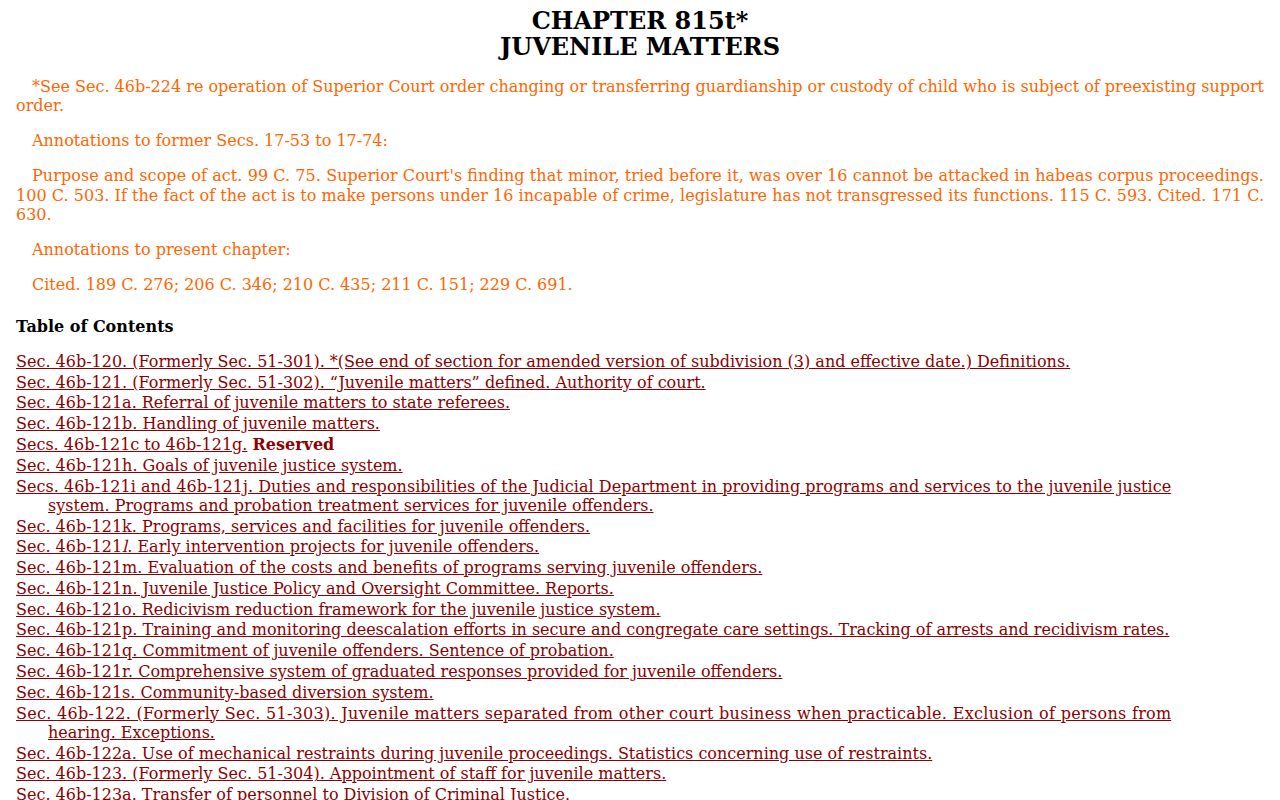
That statutory limit helps explain why some criminal or quasi-criminal matters will not appear even when a courthouse handled the underlying event.
New London Criminal Court Contacts
The Chief Clerk's Office at the assigned courthouse is the records fallback. The New London Judicial District Chief Clerk can be reached at 860-443-5363. GA 10 New London Chief Clerk can be reached at 860-443-8343. GA 21 Norwich Chief Clerk can be reached at 860-889-7338. The New London Judicial District State's Attorney prosecutes criminal cases in the district, but DCJ directs criminal-record requests to State Police, Judicial Branch, or DOC.
New London JD Public Defender
70 Huntington Street
New London, CT 06320
860-443-0490
New London GA 10 Public Defender
112 Broad Street
New London, CT 06320
860-443-5356