
New London County Arrest Records and Court Charges
New London County arrest records begin with a police or custody event. A court charge record begins when a prosecutor files the charge in Superior Court after arrest, summons, or review. Connecticut does not provide a New London County sheriff jail roster, and there is no county clerk database for arrest records. Court charge information is searched through statewide Judicial Branch criminal and motor vehicle systems, while custody status is searched through the Department of Correction.
The distinction matters. Arrest or booking information points to the law-enforcement and custody side, and the local custody page explains the statewide DOC route. The court charge record is the filed accusation tracked in court. The full criminal case file, including pleas, motions, disposition, and sentence, belongs with New London County criminal court records. Court charges after arrest can change before that full case reaches an outcome.
Find New London County Arrest Records and Charges
For filed charges, start with the Connecticut Judicial Branch criminal and motor vehicle lookup. Pending cases can be searched by defendant name or docket number, and daily dockets can be searched by defendant or court location. Use New London GA 10, New London Judicial District, or Norwich GA 21 when the form allows a local court filter. For custody, use DOC. For a formal criminal-history report, use DESPP/CCHRS. For prosecution records, do not contact DCJ expecting a public criminal record, because DCJ directs record seekers elsewhere.
- Check whether the need is custody status, charge status, or formal criminal history.
- Use the Judicial Branch criminal and motor vehicle pending search for charges filed in Superior Court.
- Filter by local court location when possible, especially GA 10 New London or GA 21 Norwich.
- Read each charge separately, because one arrest can produce more than one filed charge.
- Use DESPP criminal history procedures for a formal background record rather than relying on court lookup alone.
- Contact the Chief Clerk's Office or counsel when a charge is sealed, missing, erased, or tied to an upcoming date.
The Public Defender Services source for Geographical Area offices matters because charge questions often start in GA criminal courts.
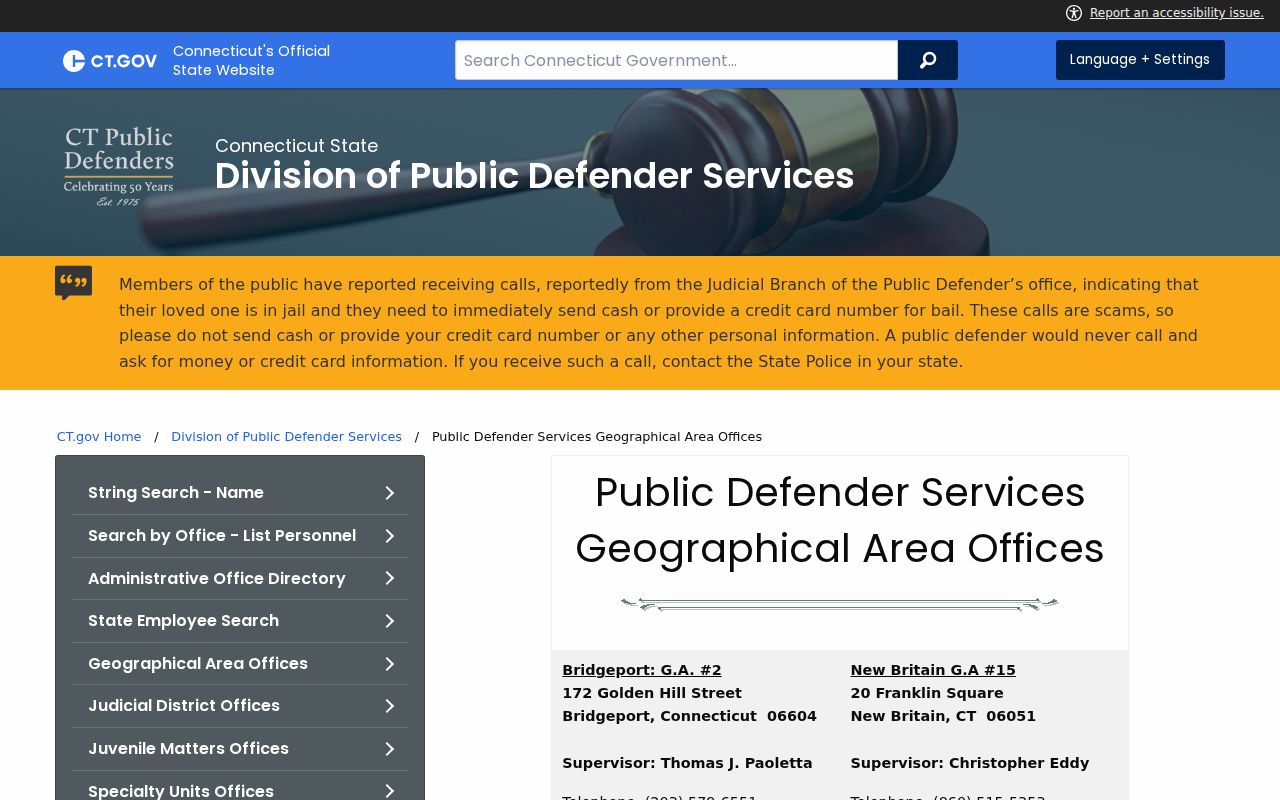
Public Defender contacts are relevant for eligible defendants, but they are not a general public-records desk for arrest records or court charges.
Charges Filed After an Arrest
A charge record starts with a formal accusation. The research describes the court charge record as narrower than the full case file: offense description, statute or charge category, court location, arraignment or docket, bond or release status when visible, and disposition when reached. Connecticut sources in this project do not provide a county-specific charge-code table, so the reliable build path is to explain the charging document and then direct readers to the filed court record.
| Document | Filed by | Use in the charge record |
|---|---|---|
| Complaint | Officer or prosecutor, depending on case route | Starts or supports a court accusation after arrest or summons. |
| Information | Prosecutor | Lists formal charges pursued in Superior Court. |
| Indictment | Grand jury route where applicable | Used for serious matters when the law requires that process. |
The New London Judicial District State's Attorney prosecutes criminal offenses in the district. The DCJ research identifies State's Attorney Paul J. Narducci and the Office of the State's Attorney, Judicial District of New London, at 70 Huntington Square in New London. That office is tied to prosecution, not routine public criminal-record searches.
The official DCJ reappointment release confirms the current New London State's Attorney context.
That prosecutor context helps separate police arrest records from the formal charges that become Superior Court records.
New London County Charge Status
Charges can change as the case moves. A pending charge is not final. A prosecutor may amend or reduce a charge, add a charge, decline to proceed, or dismiss a charge through court action. The Judicial Branch criminal lookup warns that criminal history information may change daily due to erasures, corrections, pardons, and other modifications. That warning matters when reading old charge data.
| Status | What It Means |
|---|---|
| Pending | The charge remains open and has not reached a final public outcome. |
| Amended | The filed charge was changed by prosecutor or court action. |
| Reduced | The charge was changed to a lower or different charge. |
| Dismissed | The court terminated the charge. |
| Nolle | The prosecutor declined to proceed, subject to Connecticut rules. |
| Convicted | The charge ended in a public conviction result or equivalent public outcome. |
| Erased | Eligible criminal records are unavailable to most public inquiries under Connecticut erasure law. |
Charges vs Convictions in New London County
A filed charge is not proof of guilt. It is the accusation that starts or advances the court case. A conviction is a result after plea, verdict, or equivalent legal event. Court charges after arrest may be dismissed, nolled, reduced, or erased. Public users should read each charge's status and date, then verify with the clerk or formal DESPP process if the information will be used for a serious purpose.
| Point | Charge | Conviction |
|---|---|---|
| Meaning | An accusation filed in court. | A legal outcome based on guilt or equivalent result. |
| Timing | After arrest, summons, or prosecutor review. | After plea, trial, or qualifying court disposition. |
| Can disappear from public search | Yes, through dismissal, nolle, sealing, erasure, or access limits. | Yes, through display limits, erasure, pardon, correction, or sealing. |
| Best source | Judicial Branch pending and docket searches. | Judicial Branch conviction search plus DESPP criminal history route. |
Sealed and Erased Charge Records
Connecticut research for this project uses the term erasure for qualifying criminal records. Sealing restricts public access to a file, document, or proceeding. Erasure makes eligible criminal records unavailable to most public inquiries. A missing charge result may reflect one of these limits, but it may also mean the wrong court, wrong name spelling, old display limits, or a case that never became a public court record.
| Point | Sealed | Erased |
|---|---|---|
| Public access | Restricted by statute, rule, or court order. | Unavailable to most public inquiries once eligible. |
| Record status | The record may still exist with limited access. | The law treats qualifying records as erased for public access. |
| Common context | Protected documents, restricted proceedings, juvenile or sensitive matters. | Dismissed, nolled, pardoned, or otherwise eligible criminal records. |
| Verification | Ask the clerk or counsel about lawful access. | Use court and DESPP processes tied to the record. |
Statewide Criminal History and Charges
DESPP and the State Police Bureau of Identification are the formal criminal-history route. The research notes that the DESPP criminal history request process uses CCHRS and that paper forms are no longer accepted for the new procedure. A Judicial Branch charge lookup can be useful for court status, but it is not the same as a formal statewide criminal-history response.
DCJ makes the same distinction. The Division of Criminal Justice does not provide criminal record information to the public and points users to State Police, Judicial Branch, or DOC records. For a New London County reader, that means the State's Attorney is important for prosecution and charge filing, but not the office to call for a public background report.
Note: Court charge lookup, DESPP criminal history, and DOC custody search are separate statewide channels.
Custody Records Are Separate
Connecticut has no New London County sheriff jail roster. DOC operates a unified statewide correctional system, and the research explains that Connecticut unified county jails and state prisons under the Department of Correction in 1968. For New London County readers, Corrigan Correctional Center in Uncasville is the local correctional facility to understand, but inmate search is still statewide DOC search.
Custody status can show that a person is held pretrial, but that does not prove conviction. DOC's own disclaimer says current incarceration does not necessarily mean conviction because Connecticut holds people on accused status awaiting trial. This is why arrest records, court charges, criminal court records, and inmate records must be read as different files.
Restricted New London County Arrest Records
Public access limits affect arrest and charge information. Juvenile matters are confidential under CGS 46b-124. Youthful offender cases are not shown in the criminal conviction lookup. Sealed or erased charges should not appear in ordinary public search. Some law-enforcement investigative records may be limited under public-record rules, and some court details may be restricted by court order or statute.
Vital-record statutes are not the main arrest-record law, but the Connecticut vital records statute reinforces that public records often include specific statutory restrictions on identity information.
The same principle applies to charge records: public access depends on the record type, statute, court rule, and current case status.
New London County Charge Contacts
For filed court charges, use the courthouse that has the case. GA 10 New London Chief Clerk's Office is at 112 Broad Street and can be reached at 860-443-8343. GA 21 Norwich Chief Clerk's Office is at 1 Courthouse Square and can be reached at 860-889-7338. New London Judicial District Chief Clerk's Office is at 70 Huntington Street and can be reached at 860-443-5363.
For prosecution context, the Office of the State's Attorney, Judicial District of New London is listed at 70 Huntington Square, New London, CT 06320, phone 860-443-2835. For eligible defense representation, New London JD Public Defender is listed at 70 Huntington Street, phone 860-443-0490, and New London GA 10 Public Defender is listed at 112 Broad Street, phone 860-443-5356. Public Defender Services warns the public about scam calls asking for bail money or credit card information.